SEO for Yandex: traffic that stays with you when the ads are paused
Advertising is rent: switch off the budget and the flow of customers disappears the same day. SEO is an asset: a site that brings customers from search and keeps working while your ads are on pause. I build it white-hat, for Yandex first and Google second, starting not with "keywords" but with the question of who your customer is and what they type.
I don't promise "position one in a week" and I don't buy rankings. Search engines punish that, and you pay for it. I promise honest work and clear metrics that show traffic growing.
In 30–40 minutes I'll look at your site and tell you whether SEO is worth it for you at all.
As long as you pay only for ads, you're renting traffic
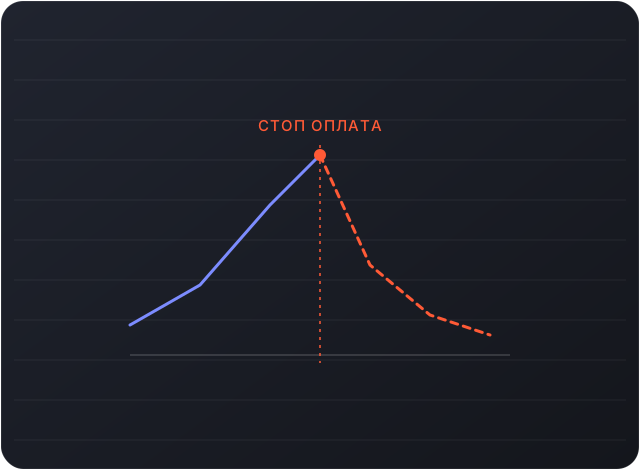
Paid advertising has an iron rule: the flow of customers lives exactly as long as the budget is on. Stop the spend, and the next day there are no inquiries, as if nothing had ever happened. Fine for a quick start. Dangerous as your only support: your whole customer flow hangs on the "top up" button.
All traffic is paid
Every customer costs money, every month, and the price only grows.
Google SEO doesn't transfer
What ranks you in Google doesn't automatically rank you in Yandex: different signals, different regional logic, different weight on commercial factors.
Translated pages don't rank
Content translated from English rarely matches how Russians phrase a search. It reads fine and gets no traffic.
Nobody knows what's working
"Positions went up" in a report, sales didn't. No connection between queries, pages and money.
How it really is: SEO doesn't replace advertising, it insures it. Slower at first, no instant inquiries. But over time it brings cheap traffic for the long run and lowers your dependence on ad budget.
Honest white-hat SEO: first who and why, then the technical work
Most SEO specialists start with keywords and technical fixes. I start with a different question: who is your customer, what do they type into Yandex, and at what moment are they ready to buy. Because you can take a site to the top for a query that brings no money and honestly report "rankings grew" while sales stay where they were.
Demand before text
Real Russian-language search demand, checked in Yandex Wordstat, not a translated keyword list.
Pages that answer and sell
Content that closes the customer's question and leads to an inquiry, not "SEO sheets" for robots.
Honest timelines
SEO is a long game. The first shifts usually show in 3–6 months, stable results later. Anyone promising the top in a week is either cheating the algorithm or selling air.
What Yandex SEO consists of
Not magic and not a pile of unrelated fixes, but a clear route. Every step solves a specific problem, and all of them work toward one thing: a site that gets found and sells.
Technical audit
Load speed, indexing, mobile usability, broken links and errors. I remove everything that stops the search engine from seeing the site properly and stops the customer from using it.
Keywords and clusters
I collect real demand and turn it into a structure: which pages are needed, for which queries and intents. The site's skeleton built around what people actually search for.
Content that answers and sells
Texts that close the customer's question and lead to an inquiry.
Commercial factors and trust
Prices, terms, contacts, reviews, guarantees: the signals that tell both Yandex and the customer that you can be trusted with money. Yandex weighs these heavily for commercial queries.
Regions and local presence
Yandex ranks by region. I set up city targeting, Yandex Business and Maps listings, so you're found where you actually sell.
Internal linking
Pages connected so authority flows where it should and the customer easily moves to the next step.
Ready for AI answers
Content shaped so Yandex's AI answers and Alice can quote you: a new traffic source most competitors haven't touched.
Analytics
Yandex Webmaster and Metrica set up so you can see which queries and pages bring traffic and inquiries, not "something grew somewhere".
Not everything is needed at once. On the review I'll say which step will do the most for you.
Yandex Ads plus SEO lowers the cost of a customer
SEO and advertising don't compete for the budget. They're two wheels of one cart. Apart, each works. Together, they strengthen each other and make every customer cheaper.
Ad data tells you what to promote
Advertising quickly shows which queries actually bring sales and which only burn budget. Those "money" queries are the ones we take into SEO, promoting by verified points, not blind.
Owning the results page
When you show for an important query in both ads and organic, you occupy more of the screen, take more clicks and give none to a competitor.
Cheaper over time
Part of the traffic gradually moves from paid to free, and the average cost of a customer across all your marketing goes down.
Ways to work on SEO
From a one-off audit to ongoing management, depending on the task, the niche and the budget.
Technical SEO audit
A deep look at the site: what blocks indexing, speed and sales, with a written plan of fixes. When you need a diagnosis and a task list, not abstractions.
Turnkey SEO
Promotion as a project with a start and a result: audit, keywords, structure, content, commercial factors. When you need to build the channel from zero.
Ongoing work
SEO on a regular basis: content, improvements, analytics, growth over the long run. For those who need a steady flow from search.
I'll name a range for your site and niche after the review. I don't quote blind.
Why trust this to me
Common questions
How is Yandex SEO different from Google SEO?
The basics overlap: a fast, indexable site with useful content. The differences matter for a foreign company: Yandex ranks by region, so a site needs a clear regional signal for the cities where you sell; it weighs commercial factors (prices, contacts, delivery terms, reviews) heavily for commercial queries; it has its own Webmaster tools and its own quality filters; and it reads Russian morphology, so keyword research must be done in Russian, not translated. Behavioral signals also carry more weight than in Google.
How long until results?
Honestly: SEO is a long game. The first shifts usually show in 3–6 months, stable results later. It all depends on the niche, the competition and the state of the site. If someone promises results in a week, that's either manipulation or air.
Do you guarantee the top position?
No, and anyone who does is deceiving you. Rankings are decided by Yandex's and Google's algorithms, not by a contractor. What I guarantee is honest white-hat work, transparent metrics and traffic growth you can see in numbers. A guaranteed top is almost always a sign of manipulation the site later gets filtered for.
Yandex or Google: which one do we optimize for?
Usually both, but the priority depends on where your customers are. In Russia the core of search traffic is in Yandex, though in many niches Google still brings a noticeable share. On the review I'll look at your analytics and tell you where the money is. That's where we invest first.
What does an SEO audit include and what does it give me?
A look at the site in three layers: technical (what stops the robot), semantic (which queries could bring you customers at all) and commercial (why people pick someone else from the results). You get a prioritized list of problems and an estimate of how much traffic is lying uncollected. An audit makes sense before investing in promotion, not after: half the planned work usually turns out to be unnecessary.
How much does Yandex SEO cost?
It depends on the state of the site, the competition in the niche and how many pages need reworking. I won't name a figure blind; that would be guessing. After the audit I name a range and a scope, and you decide whether to start now or wait. The audit is paid separately and stays with you even if we don't go on to promotion.
Can we do Yandex SEO ourselves?
Partly, yes. Collecting keywords, rewriting headings and closing technical gaps is doable in-house if you have the time. It usually breaks elsewhere: people optimize pages for queries nobody types, or chase traffic that brings no inquiries. If you do it yourself, start by checking demand, not by writing texts.
Stop renting traffic. Start building an asset.
In 30–40 minutes I'll look at your site, weigh the SEO potential in your niche and tell you honestly: whether it's worth investing, where to start and what to realistically expect. Even if the verdict is "too early for you", I'll say so.