Who your Russian customer is and why they choose
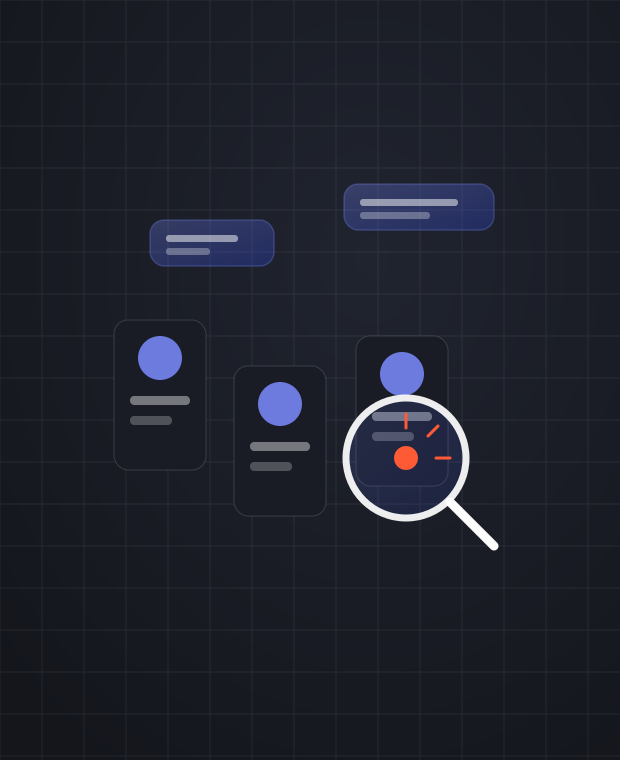
Until you know what a person really pays for, every ad, every logo and every offer is a guess. Research removes the guess. I find out who your customer is, what stress they relieve with the purchase, and by which signs they choose you or a competitor. In Russia, in Russian, with real buyers.
Not a survey for the sake of a tick. The result is a clear picture: segments, factors of choice and the language to speak to them in. The material a brand is built from and ads are launched from without being wasted.
In 30–40 minutes I'll tell you whether you need research, or whether you already have something to build on.
Decisions made "by feel" are expensive
Feel sometimes hits. More often the budget goes into ads the wrong people were waiting for, with an offer that misses.
The home-market persona
You know your customer in Germany or China. In Russia the same product is bought by different people for different reasons.
The offer misses
Ads run, clicks come, nobody converts. The message answers a question the Russian buyer isn't asking.
Everyone is "the target audience"
"Men and women 25–45, middle income" describes half the country and explains nothing.
Competitors look the same
You can't tell what people actually pay them for and where the free space in the market is.
All of these are about one thing: decisions built on assumptions about the customer instead of knowledge. Research turns assumptions into facts.
I go after the reason, not the opinion
Asking "do you like the product?" is useless: people praise and don't buy. I dig down to what a person actually did and why, not what they think they would do.
Stress as the source of demand
Behind every purchase is a tension someone wants to relieve. I look for that stress: what the person is trying to solve, what they're protecting against, what they fear. Find the stress and you've found the demand.
Behavior, not opinions
I take apart real purchase stories: how they chose, what they compared, what was the last straw. Past behavior tells the truth; a hypothetical "I would buy" lies.
The customer's own words
How the customer names their problem and its solution, in Russian. Those phrases later become headlines that hook, because the person recognizes their own words.
Segments, not an "average customer"
Different people have different factors of choice. A hedonist, an aesthete, an expert and a conservative buy the same thing differently. I separate them so we can speak to each precisely.
I rely on in-depth interview methods and Jobs to Be Done: not a "target audience portrait by demographics" but an understanding of the job you're being hired for.
What the research consists of
Not a set of activities but a logic: from talking to the market to conclusions you can lean on.
In-depth interviews
I talk to your customers (and to those who went to a competitor) using a method that brings out the truth rather than polite answers. How they decided, what made them hesitate, what settled it. In Russian, by a native speaker, so nothing is lost in translation.
Factors of choice
I sort what people choose you for into three levels: hygiene (without which nobody buys at all), differentiation (what makes you better), heroic (what makes people love and recommend you).
Segmentation
I split customers into groups not by age but by their logic of choice and picture of the world. Each segment has its own stress, its own language, its own argument.
Competitor and demand analysis
How competitors present themselves in Russia, where their gaps are, what people actually search for (Yandex Wordstat demand). Where there's unclaimed space in the market, and whether you can take it.
Conclusions and recommendations
Everything assembled into a document, in English, that makes clear: who to sell to, what to say, how to differentiate and where to start. Not "a report for the drawer" but a working map of decisions.
What you'll have in hand
Segment portraits
Who your customers really are, by logic of choice, not by passport. Who you work for and who to let go.
A map of choice factors
What people pay for, what's mandatory, where to differentiate. The thing positioning and the offer are built around.
The customer's language
The phrases people use to describe the problem. Ready lines for the site, the ads and the sales scripts.
Growth points
Where you lose customers, where you under-deliver and where there's free space in the market for you.
How we do it, stage by stage
Immersion
I get into your business, product and hypotheses: what you yourself think about the customer and why. From that come the questions worth testing.
Data collection
Customer interviews, competitor analysis, demand and numbers. I listen to the market instead of projecting my own guesses.
Analysis and synthesis
I bring the conversations and the data together into patterns: segments, factors, barriers. Signal separated from noise.
Conclusions and defense
I present the result live, answer questions, and together we decide what to do with it next. You understand the logic of every conclusion.
You don't get the research as a "black box": at the key points we check in, so the conclusions come out right and usable.
Why I can dig down to the reason
A specialization in perception
10+ years working with how people actually make buying decisions. Second degree in brand strategy. I take apart the psychology of choice, not just "audience portraits".
Research as the base of the brand
In the projects for a RUDN University research institute and an EKSMO imprint, it was the research that set the logic of everything that followed, from positioning to promotion. Without it a brand is assembled blind.
From a quick check to full research
Express research
A handful of in-depth interviews and a competitor analysis, to quickly test the main hypothesis about the Russian customer and remove the most expensive uncertainty.
Full research
A series of interviews, segmentation, factors of choice, competitors and demand, conclusions and recommendations. When you're building a brand and advertising for the long run and need a solid foundation.
Research + brand strategy
The combination: we turn the conclusions straight into positioning and a brand platform. From understanding the customer to the reason they choose you.
I'll name a range for your task after the review. I don't quote blind.
Common questions
We have few customers in Russia. Who do we interview?
In-depth interviews don't need a large sample; depth matters, not volume. Often 8–12 honest conversations give more than a questionnaire sent to a thousand people. We interview both your customers and those who chose a competitor: a refusal says as much as a purchase. If you have no Russian customers yet, we talk to people who buy this category from others.
How is this different from a survey or analytics?
A survey shows what people answer. Analytics shows what they do on the site. Neither explains why. An in-depth interview brings out the reason: what stress is behind the purchase, what made them hesitate, what settled it. You can't get a reason from a checkbox.
Do we need research if we just want ads?
Not necessarily; you can launch without it. But then the offer and the targeting are built on guesses, and the budget often goes to waste. If the budget is limited, research pays back first: it shows whom to talk to and what to say so the ads land.
Is this the same as customer development?
Almost. Customer development is the approach as a whole: testing hypotheses about the customer through conversations rather than speculation. The in-depth interview is the main tool inside it. In my work I don't ask "what do you like"; that's useless. I draw out the story of a specific purchase: what happened before it, what stress triggered it, what caused doubt and what decided it.
How do you analyze the target audience?
Not as a list like "men 25 to 45, middle income". That card gives you nothing: people of the same age and income buy differently. I divide the audience by resource state and picture of the world, because that's what decides which words a person will hear and which will pass by as noise. You get segments, each with its own fear, its own language and its own reason to buy.
What does competitor analysis give me?
It shows what people in your niche already pay for and what the customer considers normal rather than an advantage. Half the "unique selling points" on the market turn out to be hygiene: you can't differentiate with them, but lacking them removes you from the choice. Competitor analysis separates hygiene from what actually affects the decision, so you don't spend budget telling people the obvious.
What kinds of market research are there?
Roughly two families. Quantitative answers "how many": surveys, demand measurements, data analysis. Qualitative answers "why": in-depth interviews, observation, customer journey analysis. Small and mid-sized businesses usually need the second: you rarely have a sample for statistics, but a dozen honest conversations already change the offer. Counting makes sense later, when it's clear what to count.
Stop guessing. Start with a review.
In 30–40 minutes we'll go through your task and I'll tell you honestly: whether you need research, whether the express format is enough, or whether you already have data to build on. Even if we never work together, you'll leave with clarity.